How was modern India formed? From British colonial rule to the world's largest democracy
Modern India emerged from the end of British rule, the partition of the subcontinent and the integration of hundreds of princely states. Independence in 1947 established the sovereign state; the constitution that took effect in 1950 made it a republic with a common framework of government.
Neither event instantly fixed the country's present map. Former European possessions were incorporated later, internal states were reorganized and several frontier disputes remained unresolved. India's formation therefore involved both building national institutions and deciding which territories, with very different political histories, would fall within them.
India Before British Rule: Empires, Kingdoms and Regional Identities
The Indian subcontinent possessed a long history of political organization before European colonization. Ancient civilizations developed in the Indus Valley, while later centuries witnessed the emergence of numerous kingdoms, republics and imperial states. The Maurya Empire, established during the fourth century BCE, brought large parts of the subcontinent under a single imperial administration. The Gupta Empire subsequently exercised considerable influence across northern India, while powerful kingdoms developed in the Deccan and the south.
During the medieval period, the Delhi Sultanate established control over substantial parts of northern India. Beginning in the sixteenth century, the Mughal Empire expanded across much of the subcontinent, developing an elaborate administrative system and integrating diverse regions through taxation, military organization and political alliances. At its greatest extent, the Mughal Empire controlled an enormous territory, but large parts of the peninsula remained under other rulers or possessed significant autonomy. Regional powers, including the Marathas, Rajputs, Sikhs and numerous southern kingdoms, developed their own political traditions and sometimes challenged imperial authority.
By the eighteenth century, Mughal central power had weakened considerably. The subcontinent was increasingly divided among regional states whose rulers competed for territory, revenue and commercial advantages. This fragmentation created opportunities for European trading companies that had already established coastal settlements and commercial networks. It would be misleading, however, to suggest that India lacked cultural connections before British rule. Religious traditions, pilgrimage routes, literary cultures, trade networks and shared intellectual developments linked distant regions over many centuries. The word India itself possessed ancient geographical associations, although its meaning and territorial scope changed across different languages and periods.
How the British East India Company Conquered Much of India
European commercial involvement in India expanded from the late fifteenth century, beginning with Portuguese maritime expeditions and followed by Dutch, British and French trading interests. The British East India Company, established in 1600, initially operated as a commercial organization seeking access to valuable Asian markets. During the seventeenth century, the company developed trading settlements at locations including Surat, Madras, Bombay and Calcutta. These centers gradually became the foundations of British commercial and administrative power.
The Battle of Plassey in 1757 marked an important turning point. Company forces under Robert Clive defeated the Nawab of Bengal, Siraj ud-Daulah, with the assistance of local political allies. The victory substantially expanded British influence in one of the wealthiest regions of the subcontinent. The Battle of Buxar in 1764 further strengthened the company's position. In 1765, the Mughal emperor granted the East India Company revenue-collecting rights in Bengal, Bihar and Orissa, giving it direct access to enormous financial resources.
During the following decades, the company expanded through military conquest, diplomatic agreements and alliances with Indian rulers. Wars against Mysore, the Maratha Confederacy and the Sikh Empire brought additional territories under British authority. British expansion did not produce a completely uniform colonial state. Some regions came under direct company administration, while others retained their own hereditary rulers under treaties that restricted their independence. These princely states became an important feature of British imperial government. Their rulers could exercise domestic authority to varying degrees, but the British controlled their external relations and possessed extensive powers of intervention.
The Indian Rebellion of 1857 represented the most serious challenge to company rule. Beginning among soldiers serving in the Bengal Army, the uprising spread through substantial parts of northern and central India. It involved military mutinies, popular rebellions and the participation of rulers who opposed British expansion. The rebellion was eventually suppressed, but it fundamentally changed the structure of British administration. In 1858, the British government abolished company rule and transferred authority over its Indian territories directly to the Crown.
The British Raj and the Rise of Indian Nationalism
After 1858, British India was governed under the authority of the British monarchy through a colonial administration headed by a viceroy. The empire combined directly administered provinces with hundreds of princely states whose rulers accepted British paramountcy. The British introduced and expanded institutions that would later influence the independent Indian state. Railways connected distant regions, telegraph lines improved communications, and a centralized civil service administered taxation, policing and legislation. English-language higher education also created new opportunities for a growing professional and political elite. Colonial economic policies had far-reaching consequences. India became increasingly integrated into international markets, but the structure of trade often favored British industrial and commercial interests. Recurrent famines, unequal access to resources and the effects of colonial taxation contributed to criticism of British rule.
During the late nineteenth century, new political organizations began demanding greater Indian participation in government. The Indian National Congress was established in 1885 and initially sought constitutional reform within the imperial system. Over time, demands became more radical. The partition of Bengal in 1905 encouraged mass protests and the Swadeshi movement, which promoted the boycott of British goods and support for Indian production. Although the partition was reversed in 1911, it intensified nationalist mobilization. The movement for independence also reflected religious and regional diversity. The All-India Muslim League, established in 1906, sought to protect Muslim political interests within the evolving constitutional system. Hindu, Muslim, Sikh and other political leaders often cooperated against colonial rule, but disagreements emerged over representation, minority protections and the future distribution of political power.
Mahatma Gandhi became one of the central figures of Indian nationalism after returning from South Africa in 1915. His strategy emphasized mass political participation, nonviolent resistance and civil disobedience. Campaigns such as the Non-Cooperation Movement of the early 1920s and the Salt March of 1930 challenged British authority and drew millions of Indians into politics. Other nationalist leaders, including Jawaharlal Nehru, Vallabhbhai Patel, Subhas Chandra Bose and B. R. Ambedkar, represented different political philosophies and social priorities. The independence movement was not a single organization with uniform objectives; it included liberals, socialists, religious reformers, revolutionaries and advocates of marginalized communities.

The Second World War and the Decision to Partition India
The Second World War accelerated the collapse of British authority in India. In 1939, Britain declared that India was at war with Germany without obtaining the consent of elected Indian political representatives. Congress leaders protested the decision and demanded meaningful guarantees of independence. The Muslim League, led by Muhammad Ali Jinnah, pursued its own negotiations with the British and increasingly emphasized the need for separate constitutional safeguards for Muslims. In 1940, the Muslim League adopted the Lahore Resolution, which called for independent political arrangements in Muslim-majority regions of British India. This became the principal foundation of the demand for Pakistan.
In 1942, Congress launched the Quit India Movement, demanding an immediate end to British rule. British authorities arrested Gandhi, Nehru and many other leaders, suppressing much of the movement's organized activity. The war nevertheless severely weakened Britain's ability to maintain its empire. Indian soldiers had participated on an enormous scale in the Allied war effort, while economic disruption and the Bengal famine of 1943 deepened political discontent. After the war, Britain's government recognized that continued colonial rule was becoming unsustainable. Negotiations attempted to establish a constitutional framework acceptable to Congress, the Muslim League and other political interests.
The Cabinet Mission of 1946 proposed a united Indian federation with a relatively weak central government and substantial autonomy for groups of provinces. The proposal initially offered a possible compromise, but disagreements over its interpretation and implementation caused the negotiations to collapse. Communal violence intensified during 1946 and 1947, particularly in Bengal and Punjab. Political leaders increasingly doubted that independence could be achieved through a single constitutional settlement.
In June 1947, the final British viceroy, Lord Mountbatten, announced a plan to divide British India into two independent dominions: India and Pakistan. The British Parliament approved the Indian Independence Act in July 1947, and the transfer of power occurred the following month. Pakistan came into existence on 14 August, while India celebrates its independence on 15 August 1947.
Partition: Why India and Pakistan Became Separate Countries
The partition of British India created one of the largest and most traumatic population movements of the twentieth century. The new state of Pakistan consisted of two geographically separated regions: West Pakistan and East Bengal, later known as East Pakistan. Between them lay approximately 1,600 kilometers of Indian territory. The boundaries were determined principally through the partition of Punjab and Bengal, two provinces containing substantial Hindu, Muslim and Sikh populations. A boundary commission headed by the British lawyer Cyril Radcliffe was instructed to divide these provinces using religious demographics alongside other considerations. Radcliffe faced an extraordinarily difficult task. He had little time to examine the territories, and the available information could not produce a clean separation of religious communities. Towns, villages, irrigation systems, railway lines and agricultural regions were often shared by populations with different religious affiliations. The boundary awards were published after independence, intensifying uncertainty among communities that had not known which country they would belong to.
Violence escalated rapidly, particularly in Punjab. Hindus and Sikhs fled areas assigned to Pakistan, while Muslims moved from India into the new Pakistani state. Massacres, forced displacement, abductions and the destruction of property accompanied the migration. Historians commonly estimate that roughly ten to fifteen million people were displaced, while estimates of deaths vary widely, often reaching several hundred thousand and sometimes considerably more.
Partition also created major territorial and economic problems. The division of Punjab disrupted irrigation systems and transportation networks, while the partition of Bengal separated commercial centers from agricultural hinterlands. India emerged as the larger state geographically and demographically, but it did not inherit the entire territory of British India. Pakistan became a separate sovereign country, and the eastern portion of Pakistan would later gain independence as Bangladesh in 1971.

How India Incorporated Hundreds of Princely States
At independence, the Indian subcontinent contained more than 560 princely states. These territories were not directly administered as ordinary provinces of British India. Their hereditary rulers possessed varying degrees of internal autonomy under British paramountcy. When British rule ended in 1947, paramountcy over the princely states lapsed. Their rulers were encouraged to join either India or Pakistan, taking account of geographical and political circumstances.
Vallabhbhai Patel, who became India's deputy prime minister and minister responsible for states, played a central role in negotiating accession. He worked closely with civil servant V. P. Menon, who helped develop the legal and administrative arrangements required for integration. Most princely rulers agreed to sign Instruments of Accession transferring control over defense, foreign affairs and communications to the Indian government. Additional agreements subsequently integrated many states more fully into the Indian Union.
Junagadh, a princely state on the Kathiawar Peninsula, had a Muslim ruler governing a predominantly Hindu population. In 1947, its ruler announced accession to Pakistan despite the absence of a land connection between the territories. India rejected the arrangement, assumed administrative control and organized a referendum in 1948 that produced overwhelming support for joining India.
Hyderabad represented a much larger challenge. Located in the center of southern India, it possessed a substantial population and a Muslim ruler, the Nizam, who sought to preserve independence. The Indian government regarded a separate Hyderabad as incompatible with the political and geographical unity of the new state. Negotiations failed amid increasing internal conflict and violence. In September 1948, Indian armed forces entered Hyderabad during an operation officially described as a police action. The Nizam surrendered, and Hyderabad was incorporated into India. The intervention and associated communal violence caused substantial loss of life.
Jammu and Kashmir became the most enduring territorial dispute. Its Hindu ruler governed a predominantly Muslim population and initially sought to avoid joining either India or Pakistan. In October 1947, armed tribal groups entered Kashmir from Pakistan, supported by elements within Pakistan. Maharaja Hari Singh signed an Instrument of Accession to India, and Indian troops were deployed to defend the territory. The resulting war between India and Pakistan ended with a United Nations-supported ceasefire in 1949. The former princely state remained divided between areas administered by India and Pakistan. China later established control over Aksai Chin, another part of the territory claimed by India.
The Constitution of 1950 and the Reorganization of India's States
Indian leaders meanwhile worked to establish a new constitution. The Constituent Assembly had begun its work before independence and subsequently became responsible for defining the political institutions of the independent country. B. R. Ambedkar chaired the Constitution's Drafting Committee and played a central role in shaping its legal structure. The framers faced several fundamental challenges: preserving national unity, guaranteeing individual rights, accommodating religious and linguistic diversity, and preventing the concentration of power within inherited colonial institutions. The Constitution was adopted on 26 November 1949 and came fully into force on 26 January 1950. India became a sovereign democratic republic, with an elected president replacing the British monarch as head of state.
The Constitution established a parliamentary system, a federal division of powers, an independent judiciary and guarantees of fundamental rights. It also introduced universal adult suffrage, an especially significant reform in a country where earlier electoral systems had restricted political participation. Some states were former British provinces, others consisted of merged princely territories, and still others possessed special administrative arrangements. Their boundaries often reflected colonial decisions rather than the linguistic identities of their populations.
Demands for states organized along linguistic lines became increasingly influential. Telugu-speaking activists, for example, argued that they should possess a separate state rather than remain within a larger administrative unit dominated by Tamil-speaking areas. In 1953, Andhra State was created from the Telugu-speaking portions of Madras State. The development encouraged a wider examination of India's internal boundaries. The States Reorganisation Act of 1956 fundamentally transformed the map of India. It reorganized many states according to linguistic considerations while also taking account of administrative and economic needs.
Further changes followed. Bombay State was divided into Maharashtra and Gujarat in 1960. Punjab was reorganized in 1966, contributing to the creation of Haryana. Additional states emerged in northeastern India, where ethnic, linguistic and regional movements sought greater political recognition. The process continued into the twenty-first century. Chhattisgarh, Jharkhand and Uttarakhand were created in 2000, while Telangana separated from Andhra Pradesh in 2014.
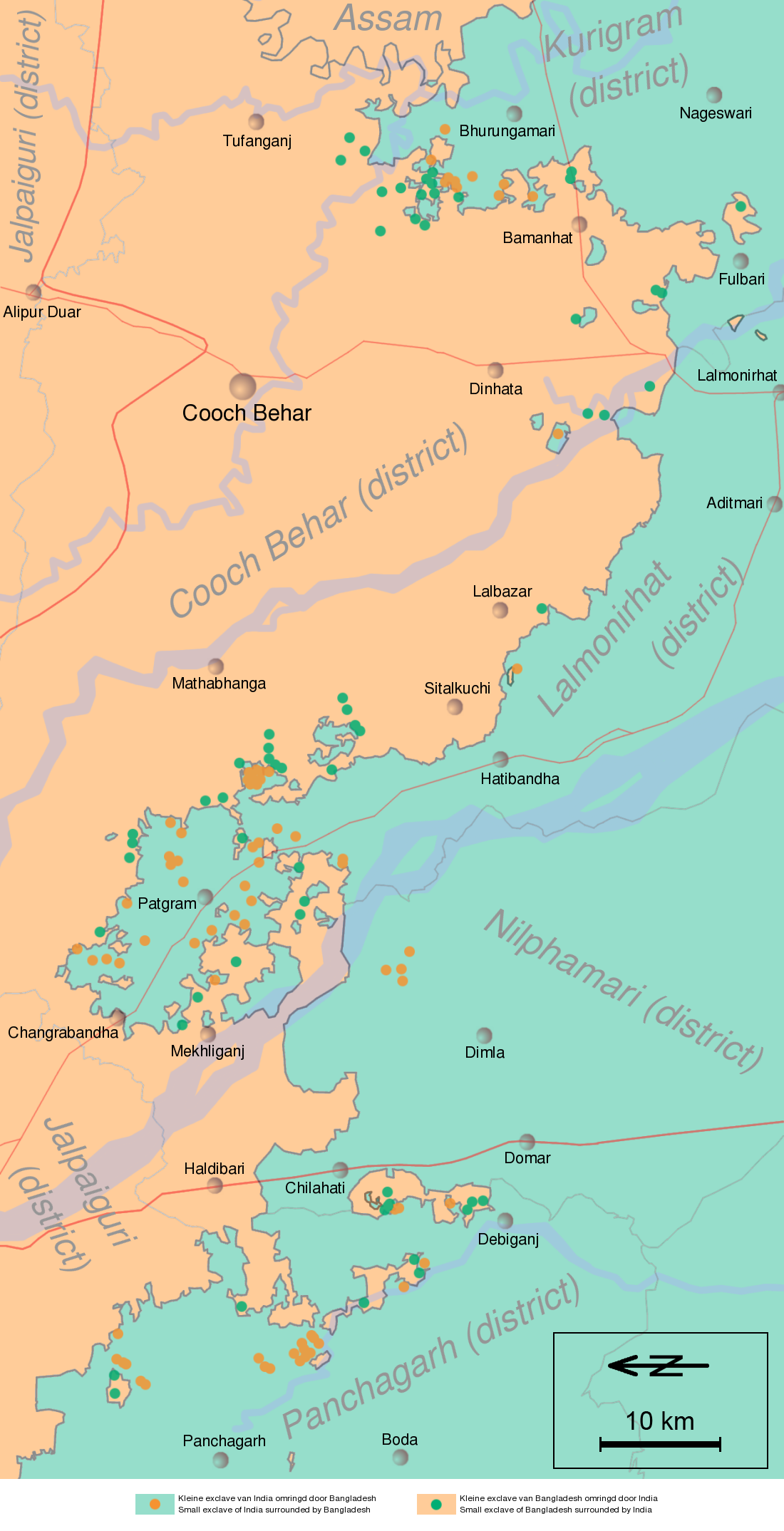
How India Acquired Its Modern Borders
The principal French settlements were transferred to Indian administration in 1954, although the formal legal transfer was completed in 1962. They later became part of the Union Territory of Pondicherry, officially renamed Puducherry.
Portugal refused to relinquish its Indian possessions. In December 1961, Indian forces entered Goa, Daman and Diu, ending Portuguese administration. Portugal did not formally recognize Indian sovereignty over these territories until after the Portuguese political revolution of 1974. Goa eventually became a separate Indian state in 1987, while Daman and Diu remained under different territorial arrangements. Sikkim followed another path. Located in the eastern Himalayas, it had been a monarchy under British influence and later became an Indian protectorate with substantial internal autonomy. Political tensions during the 1970s led to the abolition of the monarchy and a referendum in 1975, after which Sikkim became India's twenty-second state. The process remains historically controversial in some interpretations because of India's political and military involvement.
India's northern frontiers also developed through conflict with neighboring states. The border with China became especially contentious because colonial-era boundary proposals had not been accepted consistently by the governments concerned. The Sino-Indian War of 1962 resulted in a major Indian military defeat and reinforced China's control over Aksai Chin, which India continues to claim. China also disputes Indian sovereignty over Arunachal Pradesh, while India administers the territory as one of its states. The frontier between the two countries therefore remains a source of military and diplomatic tension.
The Kashmir dispute similarly continued to affect relations with Pakistan. Further wars occurred in 1965 and 1971, while later confrontations demonstrated that the division remained unresolved. The 1971 war was closely connected with the independence of Bangladesh from Pakistan, transforming India's eastern neighborhood. Within Indian-administered Jammu and Kashmir, the constitutional framework also changed. In 2019, India's central government revoked the region's special constitutional status and reorganized the former state into the Union Territories of Jammu and Kashmir and Ladakh. The decision altered internal administration but did not resolve competing territorial claims involving Pakistan and China.
Sources
- The Raj and independence, 1914–1947UK Parliament
The final decades of British rule and the political decision to transfer power.
- 1947 Indian Independence ActUK Parliament
The legislation establishing the independent dominions of India and Pakistan.
- Independence and Partition, 1947National Army Museum
Partition, mass displacement and the position of the princely states.
- The Constitution of IndiaGovernment of India, Legislative Department
The constitutional framework of the republic, its federal institutions and its territory.
- The States Reorganisation Act, 1956Government of India, India Code
The legislation reorganizing state boundaries after independence. PDF.